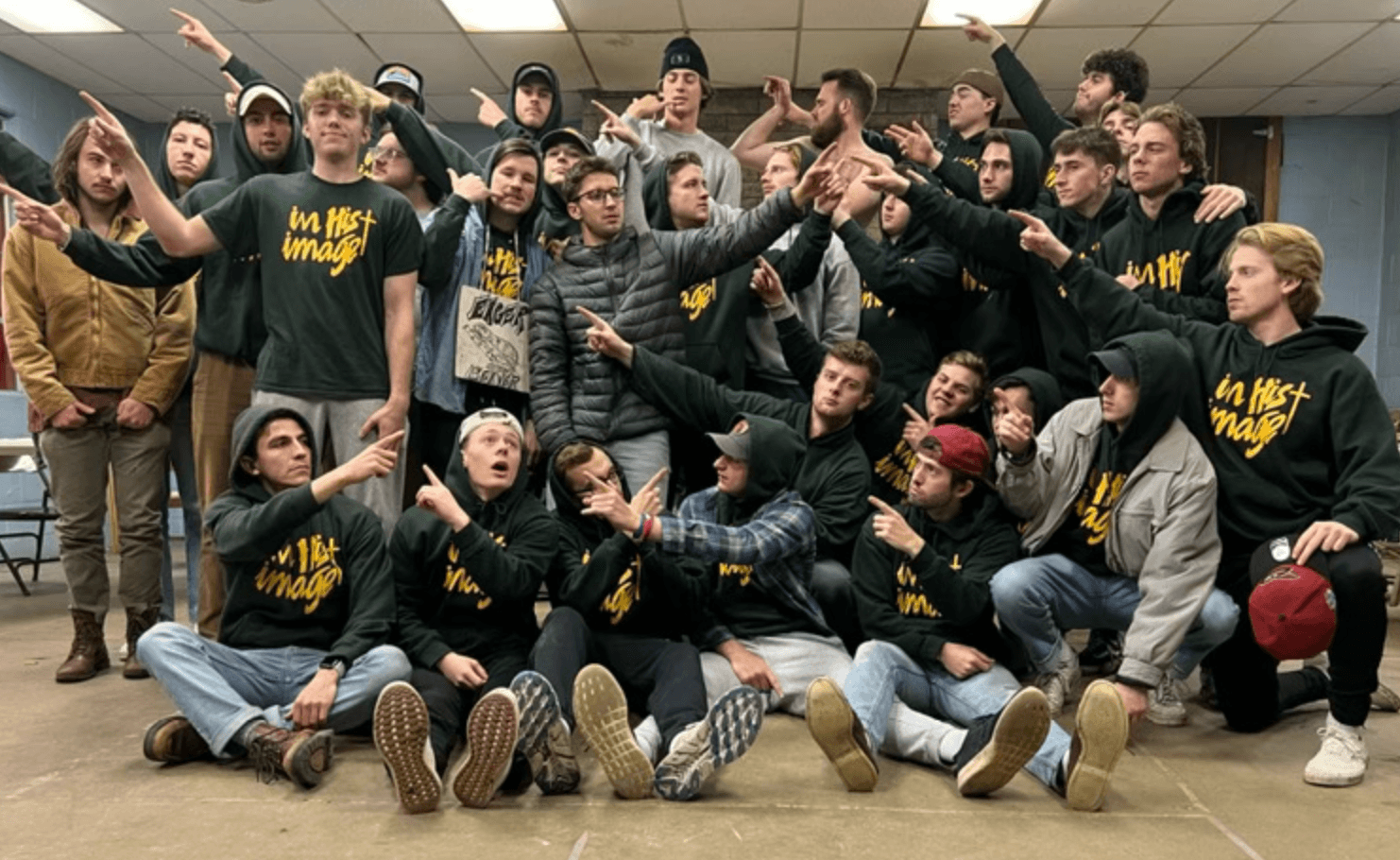
Our charism
Joy & Mirth
Our covenant names joy as a mark of the household. That isn't a mood — the Church calls it a virtue.
Why it matters here
A household built on joy
The covenant of In His Image commits the brothers to a common life of worship, study, service, and recreation — and it insists that with joy we can accomplish any task. Prayer and study get most of the attention in formation. But the Catholic tradition treats good humor, play, and rest as part of holiness too, not a break from it.
There is even a name for the virtue: eutrapelia (you-tra-PEE-lee-uh), Greek for "turning well." It is the habit of being good company — able to lighten a room at the right moment, in the right way, without cruelty or excess. Aristotle named it; St. Thomas Aquinas baptized it.
St. Thomas Aquinas · Summa Theologiae II-II, q. 168
The bow that never unstrings
Aquinas asks whether there can be a virtue about games. His answer starts with a story about St. John the Apostle.
"When some people were scandalized on finding him playing together with his disciples, he is said to have told one of them who carried a bow to shoot an arrow. And when the latter had done this several times, he asked him whether he could do it indefinitely, and the man answered that if he continued doing it, the bow would break. Whence the Blessed John drew the inference that in like manner man's mind would break if its tension were never relaxed."
Summa Theologiae II-II, q. 168, a. 2So rest of soul is not optional. Aquinas then gives three guardrails for good fun — the same ones that make a household's humor build brothers up rather than tear them down:
- Never indecent or injurious. The joke that wounds or degrades isn't wit; it's a failure of charity.
- Don't lose your head. Relaxation shouldn't dissolve the harmony of a good life.
- Read the room. Fit the fun to the person, the time, and the place.
"Now these things are directed according to the rule of reason: and a habit that operates according to reason is virtue. Therefore there can be a virtue about games."
Summa Theologiae II-II, q. 168, a. 2And yes — a lack of mirth is a vice
In the next article Aquinas goes further: a man who offers others no pleasure and is "deaf to the moderate mirth of others" is burdensome, and he calls that a fault. The tradition's word for him is boorish. Still, Aquinas adds that too much fun is worse than too little — a little salt seasons a meal.
"But little sweetness suffices to season life, just as little salt suffices for our meat."
Summa Theologiae II-II, q. 168, a. 4, quoting AristotleTranslation: Fathers of the English Dominican Province (1920). Read the full question ↗

G. K. Chesterton · Orthodoxy, 1908
The gigantic secret
"Joy, which was the small publicity of the pagan, is the gigantic secret of the Christian."
Orthodoxy, ch. IXChesterton ends his most famous book by wondering what Christ kept hidden while He walked among us. He had shown His tears and His anger openly. His guess for the one thing too great to show:
"I have sometimes fancied that it was His mirth."
Orthodoxy, ch. IXHoly and funny
Saints who knew how to laugh
Pope Francis points to these three in Gaudete et Exsultate as proof that holiness and a sense of humor go together.
St. Philip Neri
The "Apostle of Rome" and patron saint of joy, famous for pranks that humbled his own pride — and drew young men into the Church.
St. Thomas More
Lawyer, statesman, family man, martyr — and a wit to the very end, cracking jokes even on the scaffold.
St. Vincent de Paul
Spent a lifetime among the poorest of Paris and the galley slaves of France without losing his gentleness and good humor.
Gaudete et Exsultate §122–128
In his letter on the call to holiness, Pope Francis lists joy and a sense of humor among the signs of holiness in today's world. He argues that Christian joy comes from the Holy Spirit and from knowing we are loved; that it is not the same as consumer pleasure; that it grows through gratitude and generosity; and that it can coexist with real hardship. A gloomy, sour Christianity, he says, misrepresents the Gospel.
Fun fact: Beav #16, Dan Heusel, went down in history as "The Mirth-Full Beaver."